
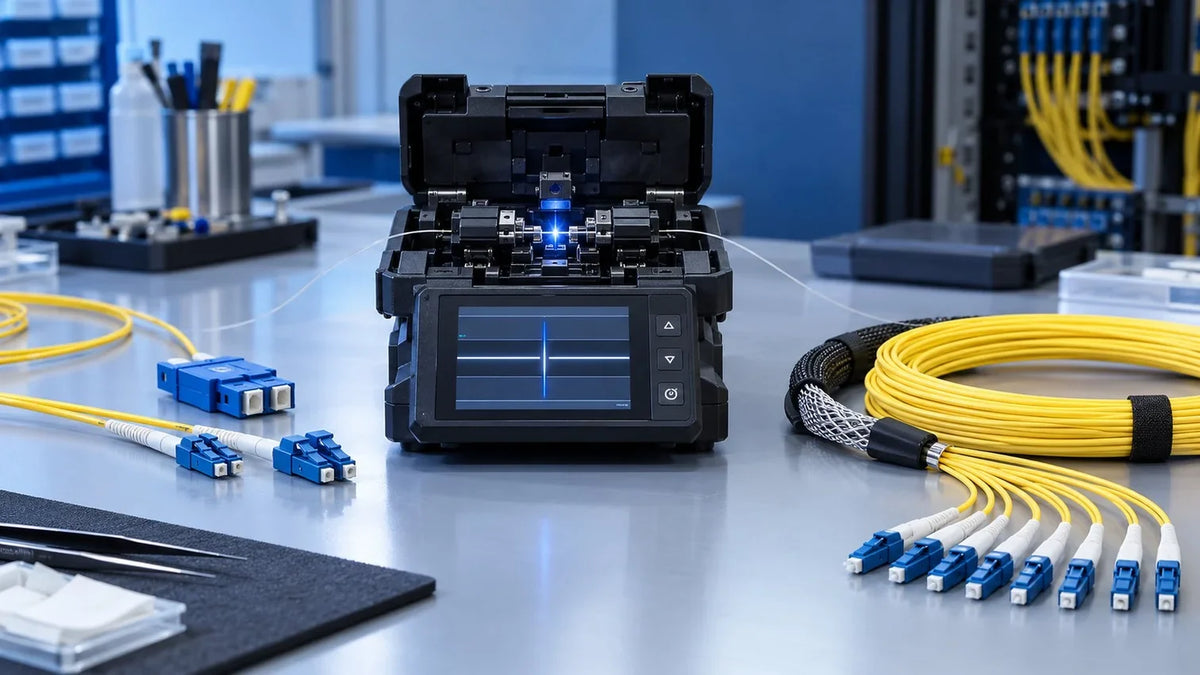

Which connection method suits your installation, maintenance, and project workflow? The three solutions in direct comparison.
View fiber optic cables in the shopDepending on the application, fiber optic cables can be connected using detachable plugs, permanent splices, or pre-terminated cables ready for installation. Which method is appropriate depends on the cable route, accessibility, fiber count, and the desired detachability.
Important: Pre-termination is not a distinct physical connection method, but a prepared termination solution—usually involving connectors. This guide compares the three common approaches and helps you narrow down the right connection for professional fiber optic installations.
The three options at a glance

The connection methods differ primarily in terms of detachability, installation effort, and planning requirements.
| Criterion | Plug connection | Fusion splice | Pre-terminated |
|---|---|---|---|
| Connection | detachable | permanent | connectors factory-mounted |
| On-site | plug and test | prepare, splice, protect | pull and connect |
| Typical use | devices and distributors | installation cables, boxes, joints | defined cable routes |
| Special feature | flexible for retrofits | splicing equipment required | exact pre-planning required |
1. Connecting fiber optic cables via connectors
A plug connection is practical if the connection needs to remain accessible for maintenance or modifications. Typical examples are connections between an active device and a patch panel or between pre-terminated cables via a suitable fiber optic coupler.
Check before plugging
- Connector type, e.g., LC, SC, or E-2000
- Fiber type: Singlemode or Multimode
- Polish: UPC or APC
- Assignment and polarity for duplex and multi-fiber connections
- Suitable coupler and clean connector end-faces
UPC and APC connectors should not be connected directly to one another. The end-faces are finished differently. APC connections are often marked in green; however, the technical specifications remain the decisive factor.
2. Connecting fibers by fusion splicing
During fusion splicing, two prepared fiber ends are precisely aligned and fused together using an electric arc. The splice point is then protected and stored in a splice cassette, splice box, or joint.
This method is used for connecting installation cables as well as for splicing on pigtails. A pigtail has a factory-mounted connector on one side; the open fiber is spliced with the installation cable.
Typical use cases
- permanently installed cables
- high fiber counts
- tight cable routes without pre-mounted connectors
- pigtails in splice boxes
- repairs and extensions
3. Using pre-terminated fiber optic cables
Pre-terminated fiber optic cables are prepared at the planned length with the required connectors. On-site fiber termination is eliminated: the cable is pulled and connected.
Before ordering, the cable route, cable length, fiber type, fiber count, connectors, polish, assignment, and installation situation should be determined. When pulling the cable, the dimensions of the protected connector ends, permissible tensile force, and bend radius must also be taken into account.
Which method fits which project?
Connecting devices
For short, accessible, and later detachable connections, a patch cable is usually appropriate.
Terminating installation cables
Fibers in a splice box are usually connected via pigtails.
Connecting distributors
With a defined cable route, a pre-terminated multi-fiber solution can reduce on-site labor.
| Project situation | Obvious method | Check before |
|---|---|---|
| Patch panel or device | Plug connection | Connector, polish, fiber, and polarity |
| Tight conduits or passages | Installation cable + subsequent splice | Conduit size, pull path, and slack |
| Measured, accessible path | Pre-terminated cable | Length, connector size, protection, and pulling aid |
| Repairing a link | Often fusion splice | Damage point, slack, protection, and measurement |
Six questions before selecting
- Does the connection need to be separable later?
- Are the cable length and path precisely known?
- Will pre-mounted connectors and their protection fit through all passages?
- How many fibers are required?
- Are splicing equipment, measurement tools, and qualified personnel available?
- What requirements apply to testing, documentation, and maintenance?
Additionally, fiber type, connectors, polish, cable construction, operating environment, bend radius, and permissible tensile load must be clarified based on the specific product data.
Conclusion: The installation situation decides
Plug connections are detachable and suitable for accessible terminations. Fusion splices create permanent connections and allow un-terminated cables to be pulled through tight passages. Pre-terminated cables shift work from the construction site to pre-production, but require reliable planning data.
In professional networks, a combination is often sensible: permanently spliced installation cables, connections built with pigtails, and pluggable patch cables to the devices.
Frequently Asked Questions
Can fiber optic cables be connected without splicing?
Yes. If both cables have matching connectors, they can be connected via a suitable fiber optic coupler. Alternatively, a fully pre-terminated link can be used.
What is the difference between a splice and a plug connection?
A fusion splice connects fibers permanently by melting them. A plug connection remains detachable and connects pre-terminated fiber ends via connectors and a coupler.
When are pigtails needed?
Pigtails provide an installation cable with a pluggable termination through splicing. The open end is spliced; the connector is inserted into the coupler.
Can a pre-terminated cable be shortened?
Not like a copper cable. Changing the length requires professional re-termination or a splice solution. The order length should therefore be carefully planned.
The right fiber optic connection for your project
Compare standard products in our shop or coordinate custom cable assembly and splicing services with abatec.